
The laboratory bench
Choosing lab supplies that fit the work
A well-equipped laboratory is built around its methods. Start with the task, then decide which instruments, consumables and records it needs.
“Lab supplies” covers a wide range: glassware, plasticware, liquid-handling tools, sample containers, weighing accessories, cleaning materials and protective equipment. These items can look interchangeable in a catalogue. In use, their dimensions, material, tolerance and compatibility often determine whether a method is practical and repeatable.
Write down the quantity you need to measure, the material it will contact, the conditions it will experience and how often the task repeats. A school teaching experiment, a water-testing service and an industrial quality-control laboratory may all use a beaker, but they will not necessarily need the same purchasing specification.
Glassware & vessels
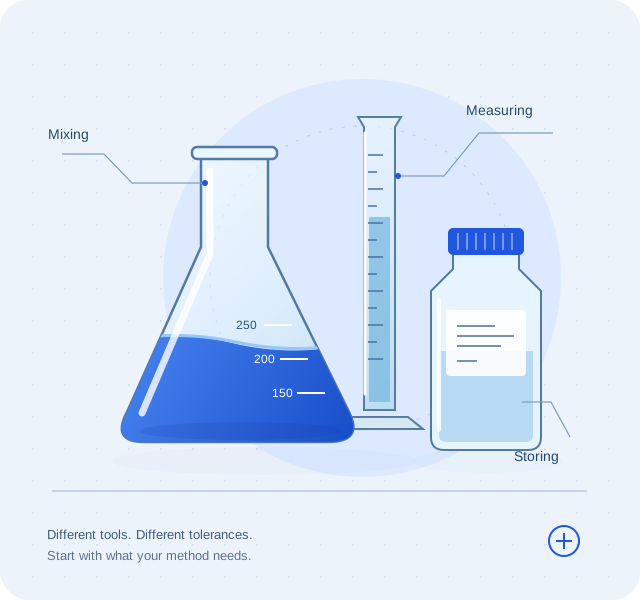
Beakers, conical flasks, measuring cylinders, volumetric flasks and storage bottles each solve a different problem. Choose by purpose before capacity.
Liquid handling
Pipettes, tips, dispensers and transfer tools need to suit the volume, the liquid and the working method. Fit and repeatability matter together.
Bench consumables
Labels, weighing boats, filter papers, racks and cleaning materials support the whole workflow. Small omissions can stop an otherwise prepared bench.
Match the vessel to the job
Choose labware by what you need it to do, rather than treating every printed scale as equally precise. Read the manufacturer's specification for the exact product, including its stated tolerance and permitted use. A catalogue photograph cannot establish those properties.
Beaker
Typical roleHolding, mixing and transferring liquids.
CheckMaterial, working capacity and whether graduations are only approximate.
Conical flask
Typical roleMixing by swirling within a narrower opening.
CheckNeck size, closure, cleaning access and equipment compatibility.
Measuring cylinder
Typical roleReading a range of liquid volumes from a scale.
CheckScale interval, tolerance, base stability and the method's requirements.
Volumetric flask
Typical roleMaking a solution up to one specified volume.
CheckCalibration mark, class, reference temperature and supplied documentation.
Laboratory bottle
Typical roleContaining and storing a specified material.
CheckBody, cap and liner compatibility; light protection and permitted conditions.
For product-specific volume tolerances and markings, consult the manufacturer's documentation. DWK's volumetric glassware reference provides further background.
Specify the complete working set
An instrument purchase is rarely complete on its own. Identify the accessories, consumables, cleaning materials and records needed to use it from the first day. For a balance, that might include a suitable bench location, compatible weighing containers and a plan for performance checks. For liquid handling, consider the pipette and tip as a working system, rather than separate catalogue decisions.
Compare the total cost over the expected working period: replacement parts, service access, consumable availability, waste handling and staff time all matter. Buying a larger pack only saves money if the contents remain suitable until they are used. An unfamiliar substitute should go through the laboratory's change process before becoming the default.
Materials & equipment
The material is part of the method
A useful container holds the sample without changing the question you are trying to answer.
Glass, polypropylene, polyethylene and fluoropolymers have different strengths and limitations. There is no single “best laboratory material”. Your choice depends on the substance, concentration, contact time, temperature and cleaning process. The suitability of the closure matters as much as the body: a compatible bottle can still be the wrong system if its liner is unsuitable.
When comparing glass
Check the stated glass type and the permitted conditions for that item. Consider visibility, cleaning, breakage, weight and whether surface interactions could affect the work. Inspect reusable pieces for damage according to your local procedure; a familiar shape is not proof that an ageing item remains suitable.
When comparing plastic
Check the polymer, additives where relevant, closure and any application-specific test claims. Think about adsorption, extractables, solvent contact and dimensional stability. Colour or recycling marks alone do not establish suitability for a laboratory method.
Always use product-specific compatibility guidance. DWK's laboratory essentials overview describes why laboratories use different materials for different applications.
Choose liquid-handling tools as a system
Define the working volume range and how often each volume is used. Ask whether the tool, tip or dispenser is intended for the liquid and technique in your method. A comfortable grip, readable setting and straightforward maintenance process can make a meaningful difference over a long session. Document the exact tip specification if it is part of the validated setup.
A tip's fit can influence performance. See Eppendorf's study of pipettes and tips (PDF) for an example of this interaction.
Plan service before equipment arrives
Before ordering a balance, meter or other instrument, confirm the available space, power supply, operating environment and service arrangements. Record who will accept delivery, who will check installation and where manuals and certificates will live. Agree the acceptance criteria before the instrument is unpacked, so a convenient first reading does not become the only test of whether it works.
Keep a named equipment record with the model, serial number, location, maintenance history and current status. A clear “ready”, “under review” or “out of service” label is more useful than relying on memory. Changes in room conditions, accessories or software may also need to be recorded, depending on the method.
The chemical store
Understand laboratory chemicals beyond the label
A chemical name identifies a starting point. The specification tells you whether that material fits your application.
When comparing laboratory chemicals, record the full name, identifying reference where appropriate, grade, concentration or assay, physical form, pack size and storage requirements. Two containers with a similar name may have different concentrations or impurity limits. Read the actual specification, rather than using price or a prominent purity figure as the deciding factor.
What chemical grades can tell you
Labels such as technical, laboratory reagent, analytical and application-specific describe intended uses or specifications, but the exact meaning depends on the supplier and standard involved. Compare stated limits and test methods. A material suitable for a general preparation may be unsuitable for a measurement that is sensitive to a particular trace impurity.
Ask which properties your method depends on. Is water content important? Does the method require a particular solvent grade, a certified concentration or a limit on a named contaminant? Put those requirements in the buying brief. A higher headline purity is not automatically a better choice when it does not address the property being measured.
Three documents, three different jobs
- Product specification
- Defines the characteristics or acceptance limits offered for the material.
- Batch certificate
- Reports the results or conformity information supplied for a particular batch. Check its scope and match the identifier to the container.
- Safety data sheet
- Describes hazards and information relevant to handling, storage and emergency measures. Use it when assessing the actual work.
A safety data sheet does not replace the workplace assessment of how a chemical will be used. HSE makes that distinction explicitly in its guidance on chemical safety data sheets. Keep the current document accessible to the people carrying out the task.
Build a useful chemical inventory
A practical inventory connects the container on the shelf with the information needed to manage it. Record the supplier, catalogue reference, batch or lot identifier, quantity, location, date received and any opening or review date required by your procedure. Make ownership clear so that a half-used bottle does not become an unexplained permanent resident.
Review inventory against planned work before placing another order. Smaller appropriate packs can reduce unused stock and make it easier to maintain current documentation. Plan how the container will be identified after repeated handling, and how a transferred portion will retain the information needed by the next person.
Plan handling, storage and disposal together
Assess the actual task, the people who could be exposed and the controls needed. Storage arrangements, cleaning and waste handling belong in that assessment. Incompatible materials may require separation; a shared alphabetical shelf is not a compatibility system. Follow the product documentation and the laboratory's assessed procedures for the specific materials involved.
For the assessment process, use HSE's COSHH assessment guidance. This guide does not provide recipes, chemical mixing instructions or a substitute for task-specific training.
From reading to result
Make laboratory measurements meaningful
A result needs context: what was measured, how it was measured and how much confidence the method supports.
Scientific equipment produces readings. A laboratory turns those readings into usable results through a defined method, suitable references and clear records. Specify the unit, sample identity, instrument and relevant conditions alongside the value. Consistent recording makes it easier to compare work across people, days and locations.
Resolution, repeatability and uncertainty
Resolution concerns the smallest displayed increment or discernible change. Repeatability describes agreement under the same specified conditions. Measurement uncertainty addresses the spread of values reasonably associated with the result. Extra digits on a display do not, by themselves, establish a smaller uncertainty.
Readings need context.
Useful accompanying information: instrument identifier, time, location, method and the uncertainty relevant to the work.
Illustrative temperature reading; not a calibration result.For a fuller explanation of uncertainty, start with the National Physical Laboratory's beginner's guide.
Keep calibration and routine checks distinct
A calibration establishes a relationship between an instrument's indications and reference values under stated conditions. A routine check asks whether the instrument continues to meet the laboratory's needs between calibrations. Both can be useful, but one should not be relabelled as the other. Choose check criteria and intervals appropriate to the use and the consequences of an error.
Before requesting calibration, explain the working range, required uncertainty and reporting needs. A certificate that covers the wrong range may offer little help for the actual method. Keep the certificate with the instrument record, and review what its results mean for continued use.
Leave a record another person can follow
A good worksheet connects the sample, equipment, materials, observations and final result. Record relevant deviations at the time rather than tidying them away later. If a calculation or spreadsheet contributes to the report, identify the version used and the checks applied to it. The aim is a clear account of the work, not a document that only its author understands.
Think about how the result will be used before collecting it. A pass/fail decision, a trend chart and an exploratory comparison can need different reporting detail. Agree the acceptance rule and any treatment of uncertainty with the people who will act on the result, rather than deciding after seeing the numbers.
The UK laboratory landscape
Find the right laboratory for the question
A useful laboratory enquiry describes the problem precisely enough for the laboratory to propose an appropriate method.
UK laboratories support education, manufacturing, environmental monitoring, materials development and many other areas of science. A university facility may support exploratory work; a contract testing laboratory may provide defined measurements for clients; an in-house quality team may monitor an established process. These are different working arrangements, so start with the service and outcome you need.
Write a clear testing brief
Describe the material or sample type, the property you want measured and the decision the result must support. Include expected ranges, the number of samples and any timing constraints. Ask the laboratory about sample quantity, container requirements, transport conditions and acceptance criteria before sending anything. A sample that arrives without the necessary context can delay the work even when the instrument is available.
Agree how the laboratory will report results, any uncertainty or detection limits relevant to your decision, and whether work will be subcontracted. Clarify what happens to remaining material, how records are retained and who can answer a technical question about the report. A quoted turnaround time should be understood alongside the sample acceptance and preparation process.
Check the scope of accreditation
UKAS accreditation to ISO/IEC 17025 concerns the competence of testing and calibration laboratories for the activities in their scope. Check the current published schedule against the specific material, measurement or method you need. A laboratory's accredited activity does not automatically cover every service on its website.
UKAS explains this in its overview of ISO/IEC 17025 laboratory accreditation. AMP Science is an educational resource and does not claim laboratory accreditation or offer testing services.
Put UK purchasing details in the specification
For equipment and supplies delivered to a UK laboratory, confirm the delivery address, receiving hours, installation needs, documentation language and service arrangements. Ask whether replacement consumables and support are available on the timescale your work requires. Include VAT treatment, carriage, installation and ongoing servicing when comparing written quotes.
For chemical supply, clarify which regulatory regime applies to the destination. Great Britain and Northern Ireland do not have identical REACH arrangements; HSE's explanation of UK REACH describes the distinction. Check current official guidance for the transaction rather than assuming that “UK delivery” answers every documentation question.
Make receiving stock part of quality control
On arrival, compare the delivery with the approved order and record any damage, mismatch or missing paperwork. Follow the agreed process for putting items into use or setting them aside for review. Keep delivery and batch information connected to the inventory record. Receiving is the point where a purchasing specification becomes a physical item on the bench.
Before you order
Build a better buying brief.
Use this checklist to turn a catalogue search into a specification. It is a planning aid, not a declaration that equipment or a chemical is suitable for a particular task.
Selections stay on this page only. No account, upload or personal details are needed.
Common questions
Laboratory questions, clearly answered
What counts as a laboratory consumable?
A consumable is an item that is used up, replaced routinely or dedicated to a particular piece of work. Examples include pipette tips, filter papers, weighing boats, labels and cleaning materials. Some laboratory purchases sit between reusable equipment and disposable supplies, so record their intended use and replacement criteria rather than relying on a category name alone.
How do I compare two lab supplies suppliers?
Give both suppliers the same written specification and ask them to identify any differences in what they offer. Compare documentation, pack size, compatibility, availability, delivery terms and ongoing support as well as unit price. Request clarification when a quote uses a broad description instead of the exact grade, model or material required by the method.
Does a higher chemical purity always mean better results?
No. Suitability depends on the properties that matter to the method. A general assay percentage does not necessarily describe water content, a particular trace impurity or an application-specific characteristic. Compare the relevant specification and test information. Buy to a defined requirement, rather than assuming that the largest percentage on the label answers every analytical question.
Can I replace one brand of consumable with another?
Possibly, but confirm compatibility and follow the laboratory's change procedure. Check dimensions, materials, documented performance and any application-specific requirements. A replacement that fits physically can still behave differently in the method. Keep a record of the decision and any checks used to support it, especially where the consumable forms part of an established instrument setup.
What should I ask before sending samples to a UK lab?
Confirm that the laboratory can answer your particular question. Agree the sample type, amount, container, identification, transport requirements and reporting needs before dispatch. Ask about acceptance checks, turnaround, subcontracting and the relevant accreditation scope if required. Give the laboratory the context needed to interpret your request instead of sending an unexplained sample and asking for “a full test”.
Is an equipment check the same as calibration?
No. A routine check assesses performance against criteria chosen for the laboratory's work. Calibration establishes a relationship to reference values under specified conditions. Keep both records clearly identified. The right approach depends on the instrument, method and consequences of an error; use the manufacturer's guidance and your laboratory's quality procedures to plan the work.
How can a laboratory reduce avoidable waste?
Start with inventory and purchasing: avoid duplicate orders, buy appropriate quantities and make ownership visible. Plan work so compatible activities can share prepared resources where the method allows. Consider reusable alternatives only when cleaning, material suitability and the full process support them. Record what is discarded and why, so the next purchasing decision can address the actual cause.
Does AMP Science sell supplies or provide laboratory testing?
This page is an educational guide to laboratory supplies, chemicals and scientific practice. It is not a supplier catalogue, an accredited laboratory directory or an offer of testing services. Use the questions and checklist to prepare your own specification, then confirm the details with the manufacturer, supplier or laboratory responsible for the work.
A quick reference
Useful laboratory language
- Acceptance criteria
- The requirements an item or result must meet before it is accepted for its intended use.
- Batch or lot
- An identifier linking a defined group of material to its production or supply records.
- Calibration
- Establishing the relationship between instrument indications and reference values under specified conditions.
- Compatibility
- Whether materials, equipment and conditions are suitable together for the intended task.
- Consumable
- An item used up or routinely replaced during laboratory work.
- Method
- A defined approach to carrying out a task or making a measurement.
- Specification
- The documented characteristics or limits used to describe what is required or supplied.
- Tolerance
- A permitted variation against a stated specification; it is not the same as measurement uncertainty.
Sources & scope
Follow the information to its source
AMP Science brings together general explanations and practical planning questions. Use the official guidance and manufacturer documentation below when you need detail. These sources support the relevant sections; they do not endorse this page or establish the suitability of a particular product.
- HSE: chemical safety data sheetsThe role of an SDS in understanding chemical hazards.
- HSE: carrying out a COSHH assessmentAssessing exposure and planning controls for actual work.
- HSE: UK REACH explainedThe scope of UK REACH and the position in Northern Ireland.
- UKAS: ISO/IEC 17025 and laboratory accreditationUnderstanding competence and the scope of laboratory accreditation.
- NPL: a beginner's guide to uncertainty of measurementAn introduction to uncertainty and why it matters.
- DWK: volumetric glasswareBackground on precision volumetric labware.
- DWK: laboratory essentialsMaterial choices across general laboratory products.
- Eppendorf: how pipette tips influence results (PDF)Why the pipette and tip need to be considered together.
Published by AMP Science on . This is general educational information. Product selection and practical work need the relevant instructions, local procedures and competent supervision. No laboratory accreditation, certification or professional review is claimed for this guide.