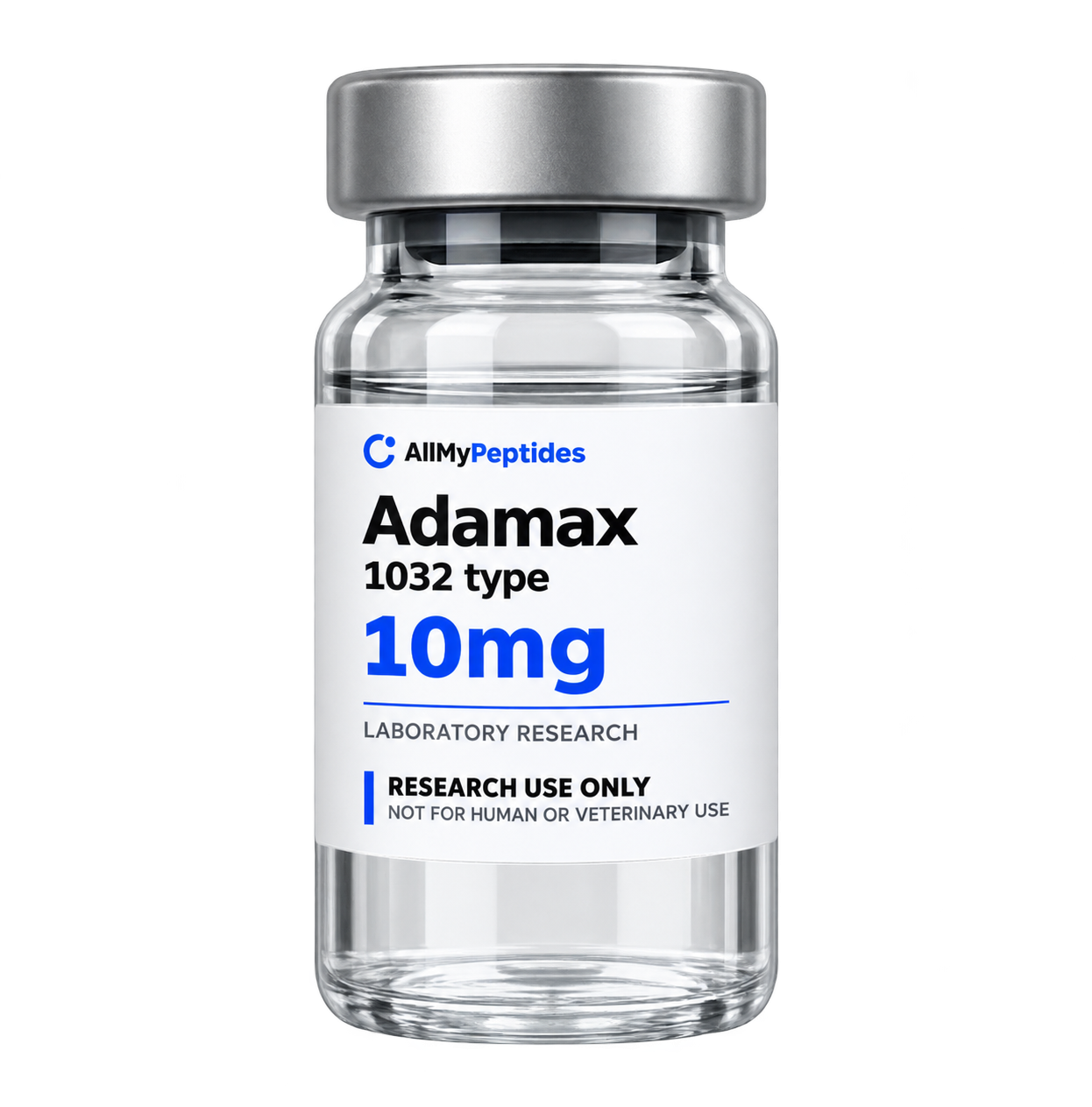
What does Adamax mean on this site?
Adamax is the supplier designation used for two research options in this catalogue:1032 and 984. Each is listed with a labelled quantity of 10mg. A definitive molecular identity for either option has not been established by the source material available for this guide.
The distinction is deliberate. A product name and a number are not a complete structural specification. Here, 1032 and 984 are retained as labels; they are not presented as verified molecular weights, doses, purity grades or measurements of relative potency. The two options should not be assumed to be interchangeable.
Keep the option label separate from the quantity
The option code and the amount on the vial answer different questions. The code identifies the catalogue choice. The 10mg field states the labelled quantity. Neither field proves the peptide sequence or identifies a particular chemical modification.
A useful record keeps both fields exactly as supplied, then adds the batch number. Do not shorten both options to “Adamax 10mg” in a sample register if that would make the received material ambiguous.
| Catalogue option | Labelled quantity | Identity status in this guide |
|---|---|---|
| 1032 | 10mg | Full supplier specification and batch identity evidence required |
| 984 | 10mg | Full supplier specification and batch identity evidence required |
What the related patent does and does not establish
The primary document reviewed here, WO2023046336A1, describes Semax-related compositions and proposes possible terminal modifications. Those passages explain why a related structure may appear in discussions of modified Semax compounds. They do not establish that a particular catalogue item is one of those structures. Read the original patent document.
A proposed structure in a patent and a verified sample identity are different kinds of evidence. The connection would still require a supplier specification and analytical results linked to the material received. We have not established a primary-source mapping from the two labels to confirmed structures for these products.
For that reason, this guide does not assign either option a formula, CAS number, amino-acid sequence, biological mechanism or claimed advantage over Semax. An attractive structural hypothesis is still a hypothesis until the relevant evidence is supplied.
Why a mass label needs more context
If a supplier explains that a number refers to molecular mass, the report should also identify its calculation basis. An average molecular mass and a monoisotopic mass use different conventions. IUPAC defines the latter using specified isotope masses; the number is meaningful only alongside the chemical identity and convention. IUPAC’s monoisotopic-mass definition.
Mass spectrometry adds another distinction: an observed peak is reported as an ion’s mass-to-charge ratio, m/z. The charge and ion assignment matter when relating it to a proposed neutral molecule. IUPAC’s mass-to-charge terminology.
These points explain what to ask for; they do not supply missing measurements. This article does not calculate an Adamax structure backwards from 1032 or 984.
The specification that would resolve the ambiguity
Request a separate specification for each option. It should identify the complete sequence if it is a peptide, stereochemistry where relevant, terminal groups and the exact location and chemistry of any modification. Ask the supplier to define what the numeric designation means.
The same record should distinguish the neutral compound from its salt or counterion form and state the basis of the labelled 10mg quantity. Keep the claimed formula and calculated mass next to the supplied structural description, rather than treating a copied mass figure as a substitute for it.
These are suggested documentation fields, not assumptions about the composition of either option. Leave an unresolved field marked “not confirmed” and retain the question sent to the supplier.
What an analytical report can add
Identity testing, chromatographic purity and peptide content address different questions. Bachem’s technical account describes these as separate quality-control measurements; a high purity percentage is not automatically a complete identity assignment or a net-content measurement. Peptide quality-control distinctions.
For an identity review, ask the testing laboratory how the reported data support the proposed structure. Keep the raw or supporting result, its interpretation and its batch identifier together. A report for a different option, an unidentified reference powder or an earlier lot is not a substitute for a clearly matched sample record.
How to read the catalogue while identity is unresolved
The Adamax product page distinguishes the 1032 and 984 options and their labelled 10mg quantities. It is the current catalogue reference, not independent proof of their chemistry. No Semax-equivalence, stability, uptake or performance claim is made in this guide.
If later documentation resolves an identity field, record the source and date rather than silently rewriting the earlier sample description. The names and modifications guide and batch-matching checklist offer related recordkeeping questions.
Sources and research scope
The linked sources support the points identified in this article. They do not certify a retail batch or establish the performance of the material in your laboratory.
A FEW MORE ANSWERS
Common questions
Are 1032 and 984 confirmed molecular weights?
Not in this catalogue guide. They are retained as supplier designations until the supplier’s structural specification and the mass convention are confirmed.
Do the options contain different labelled amounts?
Both options are labelled 10mg. Their numeric designations do not change that stated quantity.
Can I assume either option is Semax?
No. The exact identity of the supplied option must be established independently; a related name or patent proposal does not prove equivalence.
Can a purity percentage resolve the identity?
A purity result alone does not provide a complete structural assignment. Ask for evidence supporting the specified identity and matched to the relevant batch.