What is Eloralintide?
Eloralintide, also called LY3841136, is a synthetic amylin analogue. The original work by Briere and colleagues examined how it interacts with amylin and calcitonin receptors, including experiments in cells expressing defined human or rat receptors. This gives the name a specific scientific context: it refers to a reported compound with measured receptor activity. Read the original Eloralintide study.
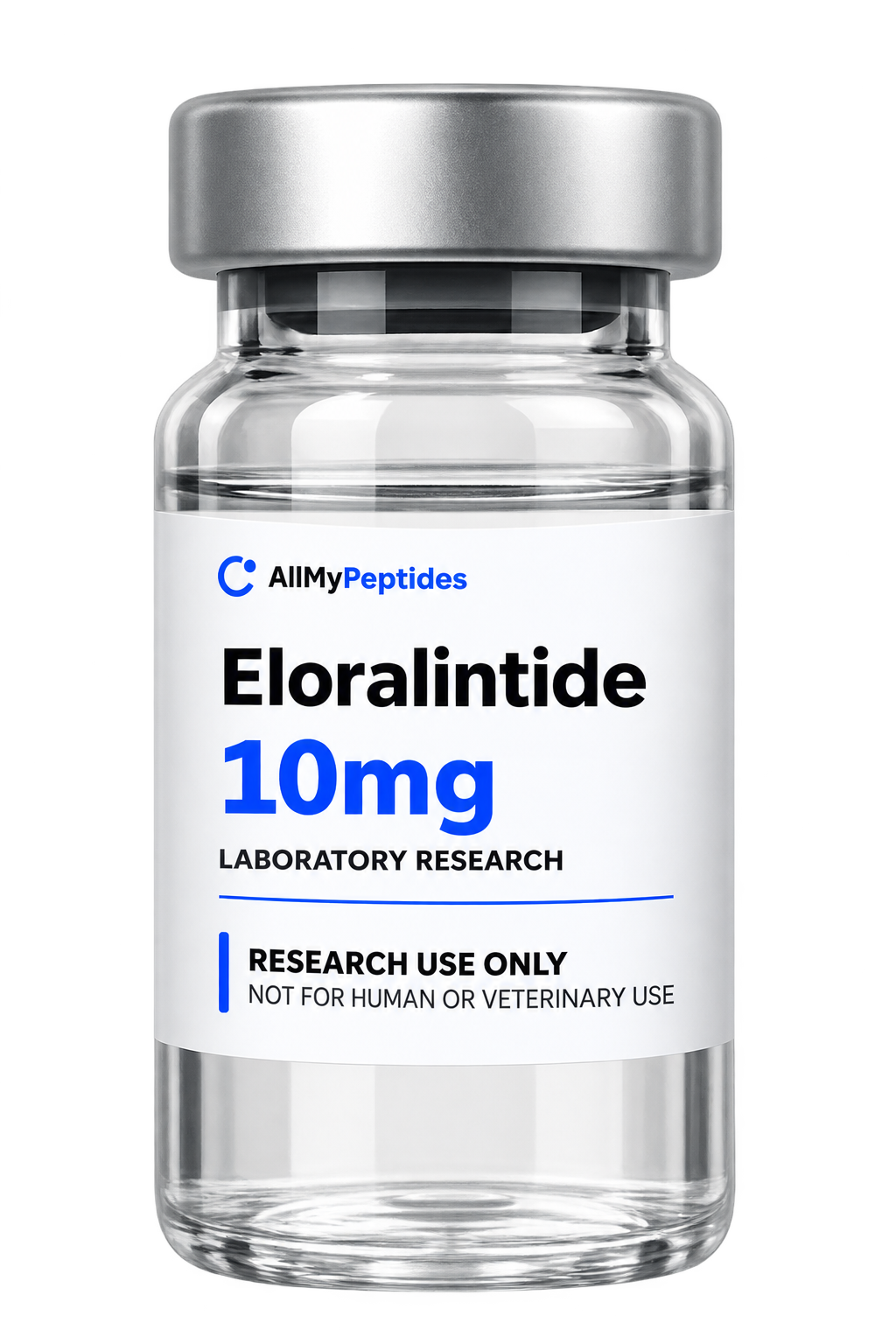
The Eloralintide product listing uses a labelled quantity of 10mg. That catalogue description is separate from the experimental material characterised in the paper. The paper does not authenticate a subsequently supplied vial, establish its composition or predict the outcome of a different assay.
Understanding the amylin-receptor names
An amylin receptor is a protein complex. Original receptor-expression experiments showed that pairing the calcitonin receptor with receptor activity-modifying proteins, or RAMPs, changes its pharmacology. AMY1R refers to the combination involving RAMP1; AMY3R involves RAMP3. These names help a reader identify what was actually present in a test system. Original calcitonin-receptor/RAMP experiments.
Record the complete receptor designation when comparing papers. A result reported for one combination should not be silently relabelled as a result for every amylin receptor. The same care applies to the species from which the receptor sequence originated.
What the original laboratory comparison showed
The Eloralintide study measured ligand binding and a functional response involving cyclic AMP, usually abbreviated cAMP. In its human-receptor assays, Eloralintide showed preferential activity at AMY1R relative to the other tested receptor types. The rat-receptor pattern was different. The finding therefore needs its assay and species qualifications; it is not an unconditional claim of exclusive action at one receptor. Human and rat assay comparisons.
Binding and response are separate observations. Binding asks about interaction with the receptor preparation; a functional assay asks what response follows under its measurement conditions. Neither result is a measurement of vial purity. A summary that merges these into one unqualified “strength” figure loses useful information.
Reading potency without overstating the result
When comparing a concentration-response plot, check the endpoint, reference compound and normalisation. A concentration associated with half of a measured response is not the same quantity as the maximum response. The two can differ independently, so a single potency comparison should not stand in for the whole experiment.
Earlier amylin-receptor experiments found that receptor isoforms and host-cell conditions can change measured pharmacology. That is a practical reason to compare compatible systems rather than rank unrelated numbers from different papers. Receptor isoform and cell-context study.
A useful reading note records the receptor, species, cell system, endpoint, comparator and uncertainty alongside the result. These are questions for evaluating published evidence, not a protocol for using this product.
What a 10mg label does and does not mean
The 10mg option describes a stated mass of supplied material. It does not specify a liquid volume, a concentration, a purity percentage or a quantity appropriate for any particular experiment. It also does not tell you whether the stated amount is expressed as peptide equivalent, salt mass or another declared basis.
Keep that basis explicit in laboratory records. If a supplier provides only a nominal quantity, record it as nominal rather than replacing it with an assumed measured value. A larger number printed on a vial would describe more labelled material, not a different receptor mechanism or a stronger molecule.
Connecting the paper to a particular sample
Before treating literature and stock as equivalent, match the supplied specification to the intended identity: the sequence and modifications where documented, the salt or counterion information, and the batch identifier. Then identify what each report actually measured. A general article, another product’s certificate or an undated marketing claim does not close a missing batch record.
For a short acceptance record, keep three headings: identity information supplied, analytical results supplied, and unresolved questions. This makes gaps visible without inventing results. Storage and handling should follow the documentation for the specific material and a laboratory-approved method; this guide supplies no universal solution lifetime or mixing recipe.
Product details and further reading
Use the Eloralintide 10mg product page for the current catalogue option and any documents actually linked to it. An illustration or a literature citation should not be treated as a batch certificate.
For related reading, see the research-evidence checklist, matching a certificate to a batch and purity versus net content. Together they provide a way to record what is known before interpreting an assay result.
Sources and research scope
The linked sources support the points identified in this article. They do not certify a retail batch or establish the performance of the material in your laboratory.
A FEW MORE ANSWERS
Common questions
Are Eloralintide and LY3841136 the same research name?
The original paper identifies Eloralintide as LY3841136. That naming correspondence does not verify the identity of an individual supplied batch.
Does 10mg specify a research concentration?
No. It is a labelled mass. A concentration also needs a defined volume and a clear statement of the quantity basis.
Does AMY1R preference apply to every assay?
No. Retain the receptor, species and experimental context when interpreting the reported preference.
Does this guide give administration instructions?
No. It covers laboratory evidence and documentation only. The listed material is not for use in or on humans or animals.