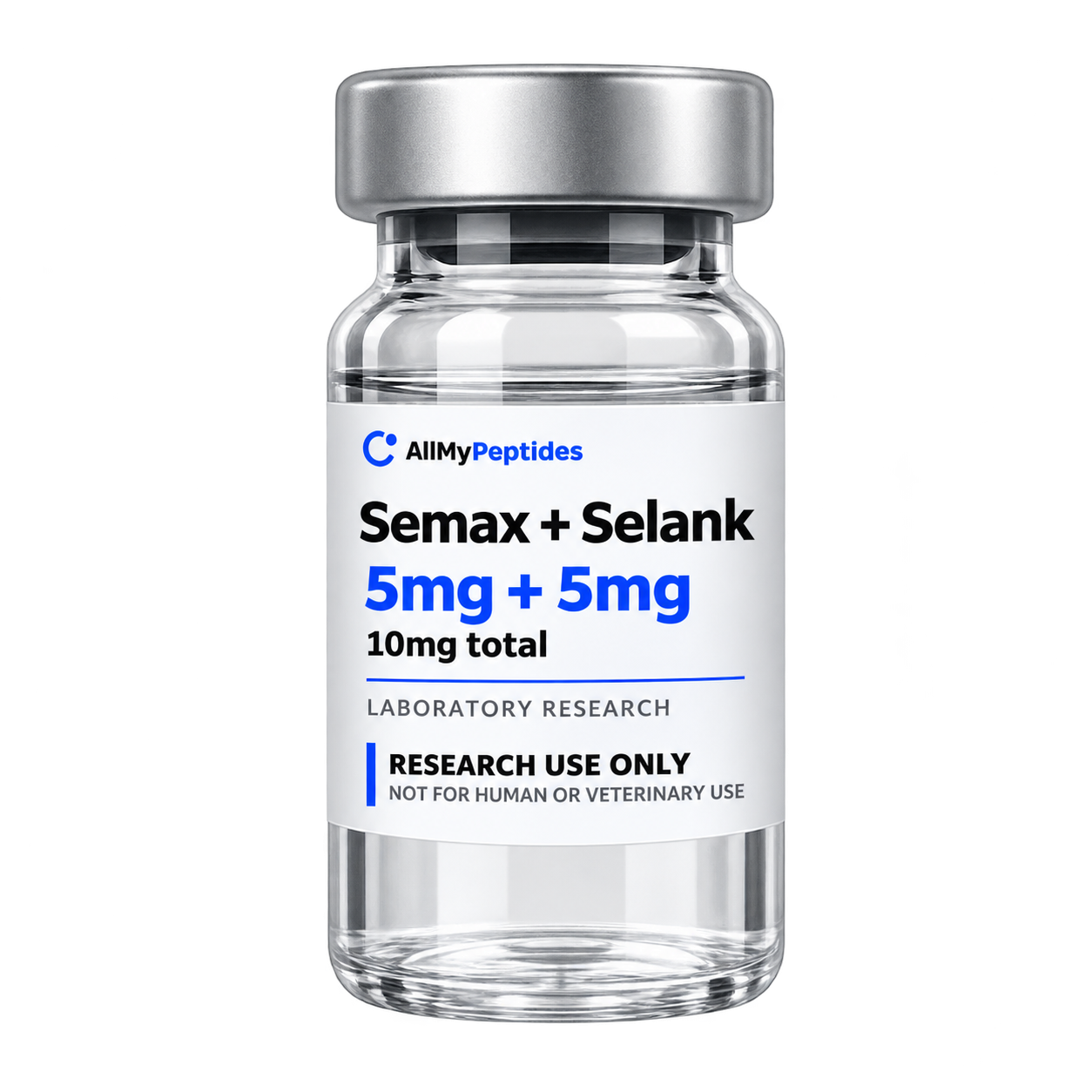
What is the Semax + Selank blend?
This catalogue entry combines two named research peptides, with a labelled 5mg of Semax and 5mg of Selank. The total stated content is 10mg. The blend name describes the proposed composition; it is not the name of a new, single peptide molecule.
That distinction matters when reading papers. A publication about Semax, a publication about Selank and a study that mentions both names can each describe different test materials. To support a claim about a finished blend, the source needs to identify that mixture and the conditions under which it was examined.
Two peptide identities to keep separate
Semax is an ACTH-fragment-related synthetic heptapeptide. Selank is a synthetic heptapeptide derived from tuftsin. An original enzyme-assay paper reports different seven-residue sequences for the two compounds. These are literature identities for the individual peptides, not analytical results for this vial. Original sequences and enzyme-assay paper. Selank’s origin in the original publication.
If a specification names an acetylated, amidated or otherwise modified form, retain that distinction rather than treating the shortened name as a complete description. The supplier’s actual specification is the document to match against the material received.
| Component | Reported sequence | Labelled amount in this listing |
|---|---|---|
| Semax | Met–Glu–His–Phe–Pro–Gly–Pro | 5mg |
| Selank | Thr–Lys–Pro–Arg–Pro–Gly–Pro | 5mg |
What the individual-compound studies measured
Dolotov and colleagues studied Semax-associated changes in BDNF and TrkB measures in rat hippocampal experiments. The work included expression and signalling readouts. It provides a defined research background, but those observations are not measurements of a Semax + Selank premix. Semax study and its measured endpoints.
Volkova and colleagues examined Selank-associated changes in neurotransmission-related gene expression in rat frontal cortex. Gene-expression changes are the measured endpoint; they should not be rewritten as proof that Selank simply acts as a direct GABA agonist. Selank gene-expression study.
Kost and colleagues reported enzyme-inhibition observations for the individual peptides. The fact that both names appear in that paper does not establish a validated 5mg + 5mg retail mixture. Individual-peptide enzyme observations.
Reading 5mg + 5mg correctly
Adding the labelled masses gives 10mg combined content. Each component accounts for half of that stated mass. It does not mean 10mg of each, and it does not specify a solution concentration.
A 1:1 mass ratio is also different from a 1:1 molar ratio. IUPAC defines molar mass through mass and amount of substance; different molecular masses mean that equal masses need not contain equal numbers of molecules. Any conversion needs confirmed component identities and an appropriate quantity basis. IUPAC’s molar-mass definition.
Record the component quantities in separate fields. Keep the total beside them so that a future reader can check the arithmetic without guessing what the blend name meant.
Why a premix needs its own evidence
A component study can motivate a research question without answering it for the mixture. Evidence about the finished blend would need to make clear which materials were combined, the composition tested, the measured outcome and the relevant comparison. Co-packaging alone cannot establish synergy.
The same principle applies to physical stability. A storage result for one peptide is not automatically a storage result for a mixture containing it. The sources reviewed here do not establish a shelf life, solution lifetime or compatibility claim for this catalogue premix. This is a limit of the evidence used in this guide, not a claim that no combination research could exist.
A useful blend documentation record
Ask whether a report covers the finished mixture or the separate materials before blending. Keep the sample description, lot identifier and method with the result. A certificate for one component cannot on its own show that the other component is present in the stated quantity.
An organised record can include the declared component list, the basis of the 5mg quantities, the identity information available for each component and any unanswered questions. Preserve the supplier’s wording where a field is uncertain. Avoid filling missing fields with values copied from an unrelated product or article.
Find the product and related research guides
The Semax + Selank blend product page is the place to check the current option and available product-specific documents. Its information should remain separate from the background literature linked here.
For a broader framework, read blend ratios and documentation, peptide names and modifications and the evidence checklist. These help identify what a source supports without adding a treatment, cognition or performance claim.
Sources and research scope
The linked sources support the points identified in this article. They do not certify a retail batch or establish the performance of the material in your laboratory.
A FEW MORE ANSWERS
Common questions
Does the 10mg blend contain 10mg of each peptide?
No. It lists 5mg of Semax and 5mg of Selank, giving 10mg combined labelled content.
Is this a single molecule with one molecular weight?
No. It is a listing for two separate peptides. Keep their chemical identities and quantity records separate.
Do papers about Semax and Selank prove synergy?
Not by mentioning both names. A combination claim needs evidence for a defined mixture and a relevant comparison.
Is there a general storage time for this blend?
No validated blend-specific storage time is established by the sources used here. Follow the documentation for the particular material and the laboratory’s approved method.