What is this two-peptide research blend?
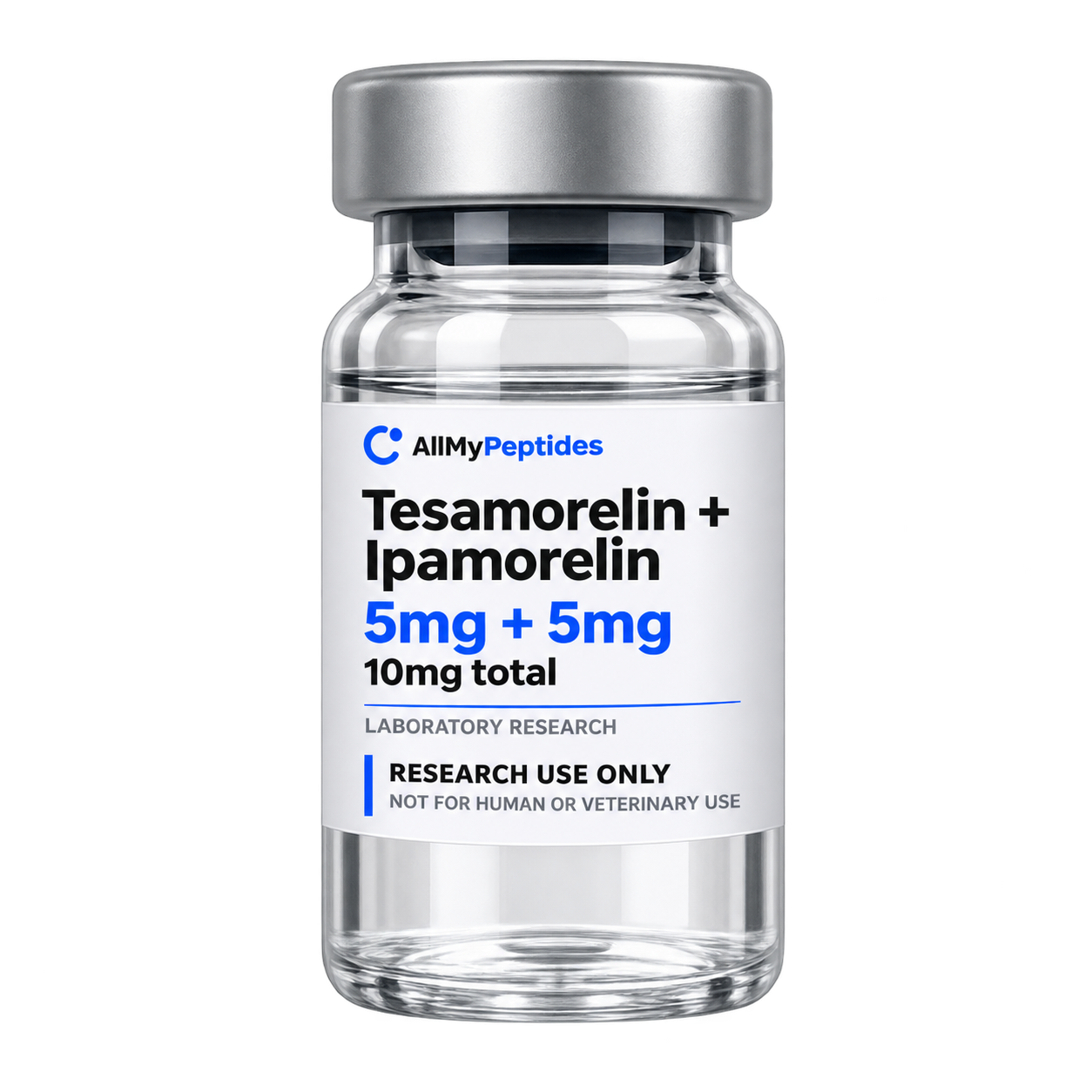
The Tesamorelin + Ipamorelin listing states 5mg of Tesamorelin and 5mg of Ipamorelin, giving 10mg combined labelled content. It describes a mixture of two separate compounds rather than a single molecule with one sequence or molecular weight.
The shared name can make their research backgrounds look simpler than they are. Each compound has its own chemical identity and evidence base. A useful review starts by separating those records, then asks whether any cited result actually tested the finished mixture being discussed.
Two different structures and receptor backgrounds
Tesamorelin is a synthetic analogue of growth hormone-releasing factor, also called growth hormone-releasing hormone. Its documented structure contains 44 amino-acid residues with an N-terminal modification. The official product description also reports in-vitro activity at human GRF receptors. Those identity facts are useful background for interpreting the name. Tesamorelin description and receptor information.
Ipamorelin is a synthetic pentapeptide. In the original work by Raun and colleagues, primary pituitary-cell experiments and antagonist comparisons supported a growth-hormone-secretagogue-receptor interpretation. That is a separate line of evidence from the tesamorelin description. Ipamorelin’s original laboratory paper.
Calling both “growth-hormone-related peptides” therefore leaves important information out. A downstream endpoint does not make the structures identical or show that the same receptor interaction was measured.
Separate component evidence from blend evidence
For each cited experiment, ask which material was tested, what endpoint was measured and what comparison was made. A cell response reported for Ipamorelin is not automatically a result for a mixture containing Tesamorelin as well. Likewise, a tesamorelin receptor description does not establish how the combination behaves.
A claim of synergy needs more than two mechanistic summaries placed next to each other. It requires a defined combination, relevant individual-component comparisons and an explanation of the expected combined response. Without those, “both influence the same pathway” remains background reasoning, not evidence that this premix has an enhanced effect.
The sources used here do not validate the composition, compatibility, stability or performance of this exact retail blend. That limit remains visible even when the individual compounds have substantial literature.
How to interpret 5mg + 5mg
The labelled amounts add to 10mg. This is a 1:1 ratio by stated mass, not evidence of equal numbers of molecules. IUPAC defines amount of substance through specified entities, such as molecules. A record of their mass answers a different question. Confirm the chemical identities and quantity basis before making a comparison of molecular amounts. IUPAC’s amount-of-substance definition.
For recordkeeping, write “Tesamorelin 5mg; Ipamorelin 5mg;10mg combined labelled content.” Do not replace that with “10mg Tesamorelin” or “10mg of each.” The label also provides no solution volume, so it is not itself a concentration.
A mass ratio does not establish an activity ratio. Keep the amount supplied separate from what an experiment later measures.
Why a medicine label is not a blend specification
The DailyMed source describes a particular tesamorelin prescription formulation. Its formulation, manufacturing specifications and handling instructions belong to that product. They do not certify an unrelated research mixture or provide handling instructions for it. Scope of the official formulation information.
This guide uses only the relevant structural and laboratory-receptor background from that source. It does not import its clinical indications, preparation directions or administration schedule. A research blend needs documentation identifying its own components, quantity basis and batch.
Questions for the finished material’s records
Request information that identifies both supplied components and explains whether analytical reports cover the finished blend or the separate starting materials. Match the sample description and lot identifier before comparing results. A report for Tesamorelin alone cannot establish the amount of Ipamorelin in a mixture.
Keep unresolved details explicit: salt forms, labelled-content basis, component-specific identity evidence and any documented storage conditions. A recommended laboratory method should be chosen by the responsible laboratory against its requirements; the presence of a product name does not establish that the material is suitable for an assay.
Do not infer a common solution lifetime from separate peptide listings. Ask for relevant evidence rather than treating a general storage slogan as a measured property of the mixture.
Product information and further reading
Check the Tesamorelin + Ipamorelin blend product page for the current catalogue option and any documents actually attached to it. This article does not state a price, stock level or unverified batch result.
The related blend documentation guide, research units guide and evidence checklist explain how to keep composition, quantity and experimental findings separate in a research record.
Sources and research scope
The linked sources support the points identified in this article. They do not certify a retail batch or establish the performance of the material in your laboratory.
A FEW MORE ANSWERS
Common questions
Does this blend contain 10mg of each peptide?
No. The listing specifies 5mg of Tesamorelin and 5mg of Ipamorelin, totalling 10mg of labelled content.
Does 1:1 mean equal molecule counts?
Not here. The stated ratio is by mass. Equal masses of different molecules are not generally equal molar amounts.
Does a tesamorelin medicine label validate this blend?
No. That information applies to a distinct specified formulation and does not certify this research mixture.
Do the individual studies establish synergy?
No. A synergy claim needs evidence about the defined combination and appropriate comparisons, not just separate component mechanisms.